On November 8, 2026, faculty and students from the Master of Global Management (MGM) program at the School of Economics and Management, Tongji University, visited the National Exhibition and Convention Center (Shanghai) for a study tour at the 9th China International Import Expo (CIIE). Under the theme “From Demonstration to Delivery: Closing the Business Loop for Intelligent Technologies,” the visit explored real-world cases at the exhibition booths to understand how intelligent technologies transition from demonstration projects into corporate workflows, production sites, and daily life, ultimately becoming sustainable commercial applications.
Exploring Intelligent Applications: Tracing the Path from Demonstration to Delivery!
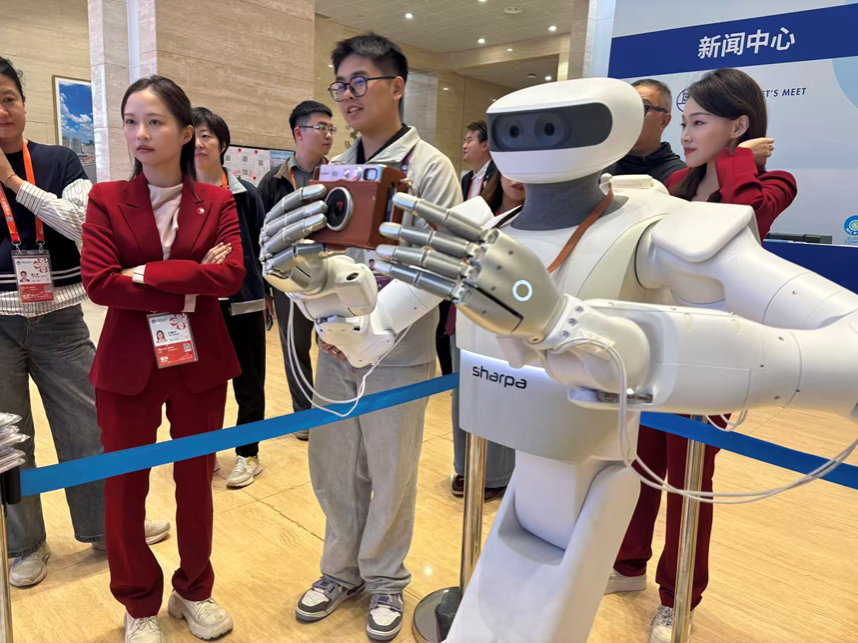
At 10:00 a.m., the faculty and students arrived at the CIIE Media Center, where they were invited to experience an instant photo service provided by humanoid robots. The group photo, printed moments after it was taken, offered a tangible glimpse of how intelligent technologies has already become part of daily life.
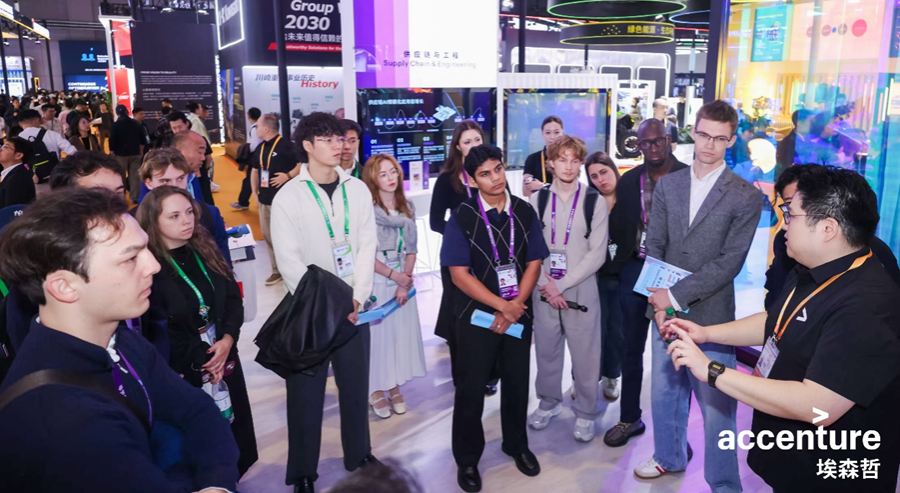
After leaving the Media Center, the faculty and students first visited the Accenture booth. Using its UMP integrated marketing platform as an example, the presenter explained how companies can address challenges in marketing content production, including high costs, fragmented processes and limited content reuse, by truly embedding AI agents throughout the entire marketing content production process. From market insights and creative generation to asset management and channel delivery, AI continuously participates and collaborates at each stage, forming an end-to-end marketing content loop. Campaign performances are then fed back into the next round of content production, transforming marketing investments into a measurable and optimizable business cycle.
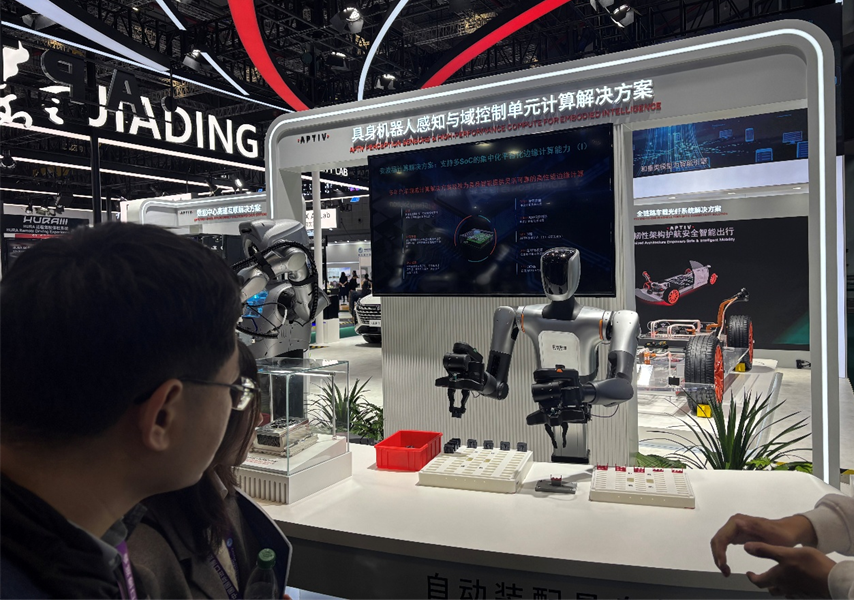
Next, the group watched a demonstration by TARS Robotics (它石智航), where an embodied-intelligence robot identified components, picked them up with precision and completed the assembly process. The demonstration helped students recognise that completing an assembly task accurately once is only the beginning: to operate on a real production line, the robot must consistently perform reliably under various working conditions. Consistent and efficient delivery is precisely what enables robots to transition from demonstrations to production lines—and from technology to commercial value.
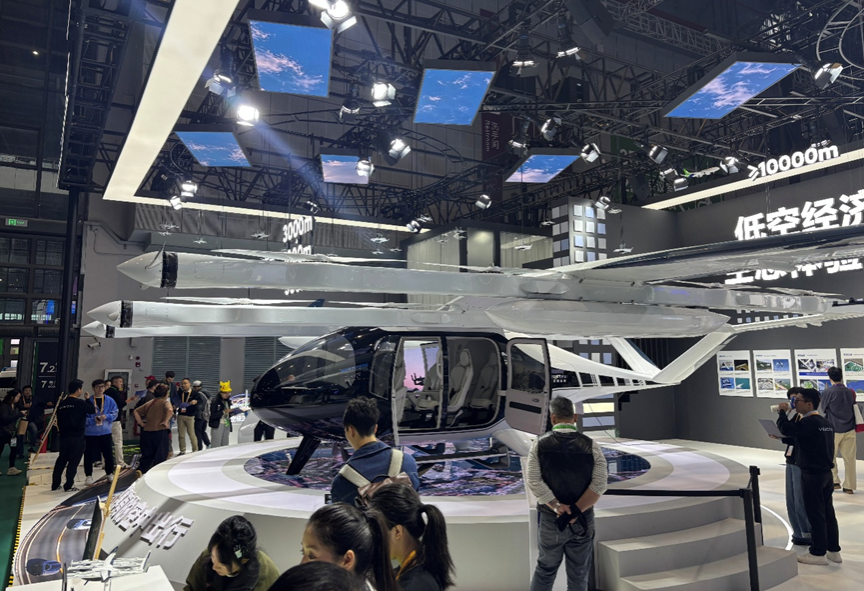
The final stop of the morning was the booth of Vertaxi(御风未来). Following the exhibition’s layout, which was organized by airspace layers, they viewed everything from drones used for inspection and emergency rescue to manned aircraft designed for future transportation. At the centre of the booth was the M1, a two-ton electric vertical take-off and landing (eVTOL) passenger aircraft featuring intelligent autonomous flight capabilities. The visit prompted students to imagine the future of low-altitude mobility, while also raising an important business question: beyond a successful technology demonstration, low-altitude mobility must establish a complete operating model—including airworthiness certification, operational network development and cost control—before it can become a scalable commercial transport service.
At the invitation of the CIIE Media Center, the group also visited the overseas exhibitor area of Dashang Group and the booth of Shiboshi. They learned about imported coffee, steak and new beer products, as well as technology for assessing durian ripeness. At the Shiboshi booth, students discovered how intelligent inspection and sorting technologies can help merchants assess durian quality without cutting the fruit open, addressing business needs such as reducing product loss and improving quality control.
After the study tour, students shared their reflections.
Juliette (French): “That instant photo stuck with me. Having a robot take our group picture made it easy to imagine how this technology could fit into everyday life.”
Alex (British): “Accenture’s demo made me think about how quickly AI can come up with several versions of a campaign, while someone still has to decide which one the brand should put its name on. I’d want to decide where that judgment belongs when designing the workflow.”
Mariia (Russian): “The visit made me pay more attention to what happens before a product reaches us. From how parts are assembled to how fruit quality is checked, I saw how smart technology is already being used in everyday processes I rarely think about.”
Tom (Italian): “As an Italian student in Shanghai, I was impressed to see innovations from so many countries in one place. Seeing how the expo connects international businesses with the Chinese market gave me a clearer sense of China’s role in global trade.”
From Successful Demonstrations to Commercial Delivery
This CIIE study tour brought classroom discussions of process design, performance evaluation and business models into a real-world exhibition setting. At Accenture’s booth, students learned how AI-assisted marketing content can be reviewed and published, with campaign results then used to guide subsequent adjustments—creating a cycle between content production and business outcomes. At the TARS Robotics booth, a precise assembly demonstration showed students that, once deployed on a production line, robots must perform the same task consistently under different operating conditions to support reliable, sustainable delivery. These observations helped students understand that significant work remains between a successful exhibition demonstration and sustained delivery in real-world settings that generates a viable business loop.
The study tour also encouraged students to consider the role they might play in technology adoption and the commercial closed-loop in future product, operations or management roles. When helping introduce a new technology, they will need to understand the needs of frontline users, monitor its actual performance and commercial returns after deployment, and communicate any issues back to the team. For the students, closing the commercial loop for intelligent technologies means making every delivery a basis for the next round of improvement—so that, through continuous iteration, technology remains responsive to people’s needs while creating lasting business value.


 SEARCH